
< Previous | Contents | Next >
Many letters written by Margaret Lucas to Newcastle, expressing anxiety as to the possible interference of the Queen in their proposed marriage, and affectionate regard, are preserved among the Welbeck Papers. On December 20, 1645, Lady Lucas writes to the Earl: "You have been pleased to honour me by your letters, my daughter much more by marriage, and thereby made her extremely happy. The state of the kingdom is such that her mother cannot give unto her that which is hers, nor can I show my love and affection towards my daughter as I would, in respect of the great burdens we groan under."1
During these years the fortunes of the King, now rapidly declining, have still some connection with Sherwood. In August, 1644, the Earl of Manchester, on his way from York to Lincoln, reduced the Marquis's house at Welbeck; and, although during the next twelve months the Abbey was retaken by the Royalists, disaster still followed the steps of Charles. Naseby was fought in June, 1645, and may be said to have given almost the final blow to the Royal cause. In the following August the King is found taking a route among the Welsh mountains in order to avoid the Parliamentary army, and, as soon as he was clear of these forces, making his way to Welbeck, where he arrived on the 15th. On the 18th of October he is again at Welbeck—this time holding a council of war. The following day Charles was at Newark, thinking of taking up his winter quarters there. On the 26th of April, 1646, the King left Oxford in disguise, and in the early morning of the tenth day following, having been travelling all the previous night, rode into the quarters of the Scottish army in Southwell2 where he thought himself a guest under friendly protection; but he was never again free, being given up to the Commissioners of Parliament by the Scotch on the 30th of January, 1647.
Often during these gloomy days in Nottinghamshire the recollection of other and happier visits to Welbeck must have passed through the mind of the King; as well as of other occasions, many years earlier, when he was the centre of attraction at the gorgeous entertainments given in his honour by Newcastle, when all the world seemed to hang upon the favourable word of him who was now a fugitive and in danger of his life.
After a residence of three years in Paris, Newcastle spent a few months in Rotterdam and then removed to Antwerp, where he remained until the Restoration, taking very little part in political events. As one of the chief delinquents he had been excluded by the Parliament from pardon, and his estates had been confiscated without the alternative of his paying a composition upon them.
The sequestration committee refused also to allow the Marchioness the share of her husband's estate usually allowed to wives of delinquents, on account of the marriage having taken place after the sequestration. Sir Charles Cavendish, however, succeeded in compounding, and by that means supplied his brother with money.
On his Majesty being invited to return to his kingdom, the Duke of York made Newcastle an offer of one of the ships sent over to convey the King, but after his long absence from England, being very impatient of any delay, he desired leave to hire a vessel for himself and his company, intending to sail at once. When, after much delay, he at last saw in the distance the smoke of London, "he merrily desired to be waked out of his dream, for 'surely,' said he, 'I have been sixteen years asleep.'"
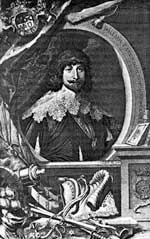
William Cavendish, First Duke of Newcastle.
As Newcastle was the greatest sufferer by the rebellion of any subject (his losses being estimated at upwards of £941,000), his friends thought he had more just title to the favour of the King than many others whose pretensions were put forward ; but his lordship, not stooping to represent his past merits, retired to Nottinghamshire, where he found his houses and parks in a very ruinous and confused condition.3 As some reward for Newcastle's services Charles II. created him Duke of Newcastle in 1665. After paying his duty to the King on his advancement, he retired to his country seats, where he lived in great plenty and respect. He died in 1676, in his 84th year, having survived, by nearly four years, the Duchess, whose Life of her husband is a work still extensively read, and said by writers of ability to be a " masterpiece in its way." But not all the respect due to her husband's services, nor to her own high position, could save the Duchess from some irreverence in the Court of Charles II.4
The married life of the Duke and Duchess is believed to have been extremely happy. The Duchess was a very voluminous writer, and in her later life maintained a great number of young ladies about her person who occasionally wrote to her dictation, and some of whom slept in a room contiguous to that in which her Grace lay, and were ready at the call of her bell to rise at any hour of the night to write down her conceptions, lest they should escape her memory.
Pepys said of the Duchess: "The whole story of this lady is a romance, and all that she does is romantic. Her footmen in velvet coats, and herself in an antique dress, as they say . . . there is as much expectation of her coming to Court, that so people may see her, as if she were Queen of Sweden."
On Newcastle's death the title passed to his second son, Henry Cavendish, who married Frances, daughter of William Pierrepont, of Thoresby. The second Duke does not appear to have been a man of great talent. He is found making a favourite of one of his daughters, which he both denies and confirms in a letter from Welbeck in May, 1684, where he says: " I am in no treaty of marriage for my daughter Katherine. You said very true to Lord Plymouth that I would give her £10,000 at present, and if I have no son will be very kind to her out of my estates. Lord Thanet is a person for whom I have a great esteem, and an alliance with him will be very pleasing to me, but he could not have seen Kate since she was a grown woman, and I believe he saw my daughter Margaret at the same time. I confess to you I would much rather marry my elder daughter Margaret before my daughter Katherine. They are equally dear to me, but if I make any difference, the advantage will be Margaret. I will give her more at present and much more hereafter. May be if Lord Thanet sees them he will change his mind from Kate for her, which would be highly pleasing to me and my wife, whose favourite and mine she has always been. Yet, I have so great esteem for Lord Thanet that I will say what I never did to any yet, when he sees them he shall make his choice."5 Lord Thanet, notwithstanding this tempting offer, honourably adhered to the younger lady, Katherine. A few years afterwards the Earl of Clare married the eldest daughter, Margaret, whose dowry was double the amount promised to Katherine.
This Earl of Clare was, through his mother, a descendant of Bess of Hardwick, and perhaps he may have inherited some of her shrewdness in the management of affairs, for one cannot help thinking that he owed his elevation in the world to his practice of pushing his own interests to the detriment of others, and thus became one of the most wealthy and powerful men in the kingdom. On April 18, 1691, he writes to the King from Haughton, asking for an advance in title : ". . . My Lord Newcastle is very importunate with me since your majesty has created a Duke of Belfast and others are reported will be made, to remind you of your most gracious promise to me, wherein Sir, you was pleased to assure me, whenever any person was advanced to that honour, I should certainly be one. Your sacred word, for my owne poore endeavours never to deserve the lessening of your favours to me, give the greater assurance than if I had never so many to speak in my behalf, which I have wholly deprived myself of by looking upon it as my duty to keep your favours design'd me secret from all but my father-in-law; the great consequence it is to me in regard to him as I formerly acquainted your majesty must make this favour by your servant appear reasonable to all but whom malice or envy blinds. His humours whom I am obliged to gratify, and your majesty's goodness to me, I beg may in some measure obtain my pardon for this trouble, and the presumption of imploring a line in answer that I may shew my Lord Newcastle. This honour would be a perpetual obligation both upon my own and my wives family, ... as I was with the earliest here in your interest so I know no ambition beyond living and dying in the same. ..."
On the death of the second Duke, which took place shortly after the date of the above letter to the King, it is related by Collins, that " Clare having been one of the first to welcome the Prince of Orange on his claiming the throne, . . . ventured on All Saints Day 1691, to move the king in his bedchamber to bestow on him the title of Duke of Newcastle, and the garter, which were his father's, and his majesty not readily assenting to confer these honours upon him, he instantly surrendered up to the king his place of gentleman of the bedchamber, and the other offices he held. ... His lordship soon after retired to his seats in Nottinghamshire, taking his favourite diversion in hunting, and minding the improvement of his estates."
This action not producing the desired effect, Clare again addressed the King: "Hearing by my Lord of Oxford your majesty did misapprehend me, fearing you might think anything I did was throw want of respect, when it proceeded purely because your Majesty had since assured me whenever you made any Duke I should certainly be one, it being a general received opinion that what honours had been bestowed upon a parent, the heir had the best right to the king's favour. Not being sensible I had done anything to forfeit your Majesties goodwill, made me conclud, if I could not prevail to have some assurance before the end of the winter of receiving some marks of your favour, was such a testimony upon this occasion of your displeasure, and of your Majesties having been told false, malitious, stories of me, that I thought I could not avoid laying what I had the honour to hold under you, at your feet, and this cut me to the soul, being certain no servant you have has more promoted your interest here; and without vanity I may affirm my fortune gives me more powers to do it than any subject your Majesty has."
When it was found that the Duke had bequeathed the bulk of his estates to his elder daughter, the Countess of Clare, dissensions arose in the family, and the disputes were afterwards carried to the Law Courts, where they were decided in favour of Clare, and culminated in a duel between Clare and Thanet, in which both combatants were wounded.
A considerable portion of the timber used for the great beams in St. Paul's Cathedral was grown at Welbeck; and in 1693 the Archbishop of York reminded the Earl of Clare of his promise to give as many oaks out of the park at Welbeck towards the fabric of York Minster as he gave to St. Paul's.
On succeeding to the estates of Denzil, Lord Holles of Ifield, Clare's efforts were crowned with success; the long-coveted title was bestowed upon him on May 14, 1694.
< Previous | Contents | Next >
1 After the capitulation of Colchester in August, 1648, Sir Charles
Lucas, brother of the Duchess of Newcastle, was by court martial condemned
(as it was said unjustly) to death. This sentence was the result of the
exasperation of the Puritans against the authors of the second civil
war.
Another brother of the Duchess,- Sir Thomas Lucas, married Mary, daughter
of Sir John Byron, of Newstead.
2 It is said
to have been at the "Saracen's Head" that the King gave himself
into the hands of the Scottish army, which is supposed to have been an
inn some centuries before the time of Charles I.
3 "His two houses of Welbeck and Bolsover were
much out of repair, and the latter, half pulled down, without any furniture
or goods left in them except some few hangings and pictures, saved by the
care and industry of his eldest daughter the Lady Cheyney, which were bought
over again after the death of his eldest son Charles, Lord Mansfield .
. . who, dying without issue, and leaving some debts to be paid, his lordship
sent to his other son, Henry, Earl of Ogle, to procure so much credit as
would purchase the said hangings and pictures which were much esteemed
by him, as the latter were drawn by the famous Vandyke."—Collins'
Historical Account of the Cavendish Family.
4 Dictionary of National Biography.
5 Historical Manuscripts Commission, Welbeck Papers.