< Previous | Contents | Next >
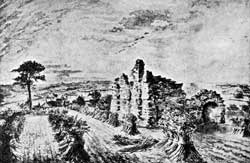
Ruins of the King's house, Clipston.
Edward the Second was deposed on January 25, 1327, and murdered at Berkley Castle on September 2oth, in the same year.
The reign of Edward the Third commenced January 25, 1327, and during that year he granted letters patent for the chantry within the manor of Clipston.
The same year the King appointed Robert de Clipston Keeper of the Pale of Clipston in Sherwood, to hold during pleasure, &c.
Also, during this year, John de Crumbwell, warden of the forests north of the Trent, was directed to recompense the men and tenants of the vill of Kings' Clipston for the losses they sustained by the inclosure which our lord, Edward, the late King, made in the ancient wood called Clipston Park, in Clipston Dam, and in other places in the Forest. These men and tenants were to have common of pasture for all kinds of cattle and flocks—except goats—in the King's Hay of Birk-land; also, by the King's will, they may have Fugeria and Folia in Clipston Park, on condition of paying thirteen shillings and four pence annually.1
Edward was at Clipston on the 28th of November. From thence he sent to Charles, King of France, requesting that justice may be done to William de Rydale, an English merchant, whose woad was arrested at Amiens.
On the same day the King sent a safe conduct for Bartholomew de Burghersh, Constable of Dover Castle, and William de Clynton—who was to accompany William, Count de Hainault, and his daughter Philippa, into England. This Philippa was married to the King in the following January, and became mother of the Black Prince. At the time of his marriage Edward was little more than fifteen, and his bride was still younger. During the following year the King again granted Robert de Clipston the custody of the Manor and Park of Clipston, to hold so long as he should well and faithfully perform his office. He was to keep the Manor in repair at the King's cost, and the Park pale at his own, receiving, for the latter duty, timber of the dry wood there, and taking every day for himself, the parkers, and makers of the said pale, 7d.
In 1329-30 information was dispatched to the Sheriff that the "great gate and sluice of our Mill at Clipston, at the head of our great Dam there, are very weak and ruinous, and that the bursting of that Dam, and loss of our fish therein, is to be feared, unless the gate and sluice are repaired. You are commanded, therefore, to repair the same, for which ten marks will suffice."
In 1335, from Clipston, on the 9th of April, Edward directs the Archbishop of York to permit the cross to be carried in the province of York before the Archbishop of Canterbury on his way to the Parliament at York. A fortnight afterwards the King orders the Sheriffs of Notts and York to protect the Archbishop of Canterbury (bearing his cross) on his journey to the Parliament summoned to York on the morrow of Ascension Day.
1336-37.—The Jury, this year, said that Peter Witheberd, of Kings' Clipston, had a messuage and one bovate and a half in Kings' Clipston, by the service of two shillings and sixpence annually, according to the custom of the Manor of Kings' Clipston, of the ancient demesne of the Crown, and William Witheberd was his son and heir, and above thirty years old.
In 1339-40 the King granted to his valet (Robert de Maule), for good service, the custody of his Manor and Park of Clipston.
The same year an inquisition resulted in the report that Henry de Wytheton, Chaplain within the Manor of Clipston, had, for his sustenance, five marks per annum.
The last recorded visit of Edward the Third was on the 20th of September, 1350, when he granted hence a License of Mortmain to the Hospital of St. John the Baptist in Nottingham.
Edward the Third was graceful in person. His manners were courtly, and his voice winning. He loved hunting, and hawking, and the practice of knightly exercises; yet, after a reign of fifty years, he died in a dishonoured old age, robbed on his deathbed even of his finger rings, by the vile mistress to whom he had clung.2
He was succeeded by the son of the Black Prince, Richard the Second, who is not known ever to have visited Clipston, and with the failure of the Plantagenet line, the importance of the place declined. Scarcely had Henry the Fourth been on the throne a year when, in consideration of the Earl of March transferring his homage from the King of Scotland to himself, he granted to the Earl the Manor of Clipston, with other appurtenances, for life.
The same King, in the seventh year of his reign, granted an annuity of £4 10s., issuing out of the fee farm of Clipston, in the forest of Sherwood, together with the profits and advantages of the verdure and herbage of the garden, called the Halgarth, in which the Manor House of Clipston is situated, to Adam Bell. Hunter, the historian, believes that this Adam Bell was one of three famous men—"Adam Bell, Clym of the Clough, and William of Cloudesley," the heroes of the ballad quoted in Percys Reliques. The desertion of Adam Bell to the Scots afterwards, caused the resumption of the grant.
In 1452 the whole township was granted to Edmund, Earl of Richmond, and Jasper, Earl of Pembroke, for their lives. The Earl of Richmond died in 1456, leaving a son a few weeks old, who became Henry VII.
In consideration of faithful services, good disposition, and because he for a long time occupied the same by gift of Edward IV., Richard Scholey, chaplain, in 1486 was given a grant for life of the Chantry within the Manor of Clipston, together with the Chapel of St. Edwin, within the forest of Sherwood, with 100s. yearly.
Henry VIII. bestowed the Manor of Clipston and other rewards on Thomas Howard, Earl of Surrey, on his creation as Duke of Norfolk, for his gallant conduct as commander of the English army at the battle of Flodden Field, where the Scots were defeated and their king and many others of their nobility left dead upon the field.
In 1524, Thomas Manners, Lord Roos, was appointed Warden and Chief Justice Itinerant of Sherwood Forest, and of the parks, Bilhagh, Birkland, Rumwood, Owseland, Fulwood, Bestwood, and Clipston.
A commission, consisting of the Abbots of Welbeck and Rufford, the Prior of Newstead, Sir Brian Stapleton, and others, was appointed in 1531, to survey and report on the condition of Nottingham Castle, and the parks of Nottingham, Bestwood, and Clipston; the forest of Sherwood, and the woods of Thorneywood. Also the quantity of deer in the said manors. The commissioners report that from their view on the 15th of January, 1532, there were in Clipston sproggs, 310 red deer, of which 70 were deer of antler; in Clipston Park 100 fallow deer, of which 25 were deer of antler. Red deer within the forest, without the parks— counting six score to the hundred—1,616.
The number of red deer in Clipston Park exceeded that of any other place in Sherwood Forest.
It is not known that during the sixteenth century "The Castle," as in some documents it is called, was occupied, and it is very probable that on the dissolution of the monasteries the chaplain's office would be abolished, and the prayers instituted by King John three hundred years before, for the repose of the soul of his father, would come to an end.
In a survey of Sherwood Forest made in 1609—among the measurements, Clipston Park is stated to contain 1,583 acres, 1 rood, and 35 poles.
Either from neglect or some other cause, it may be inferred that during the reign of Elizabeth the Kings' House was far on its way to decay, for when Thomas Markham, of Ollerton, was appointed Keeper of Clipston Manor, it is described as "the late castle." In the time of James I., Clipston passed into the hands of the feoffees of Gilbert, Earl of Shrewsbury, and afterwards became the inheritance of William Cavendish (grandson of the celebrated Countess of Shrewsbury), who was created Earl, Marquis, and afterwards Duke of Newcastle. During the Civil War, Newcastle, when not fighting the King's battles, was in exile, and something may be learned of the treatment that Clipston Park received during the time of the Commonwealth, from the report of the four Verderers and Ranger of Sherwood Forest, made in April, 1655, to the Lord Warden, John, Earl of Clare. It is there stated that "The Forest is ruined, especially Clipston Woods ... by Mr. Clark, on pretence of a grant from the committee for the sale of traitors' estates. He has felled one thousand trees, and daily fells more, having sold three hundred to Phillips of Bawley, for ship timber. He fells in the heart of the forest, where the deer have their greatest relief." This Mr. Clark had obtained leave to take twenty-eight thousand trees from Sherwood Forest. The report goes on to say that he "sets on all the workmen he can get at very high wages. ... He sweeps clean, leaving no standards, according to law, which will bare of timber a forest that stands near two navigable rivers, the Trent and Idle."3
In 1810 a disastrous event happened to the remains of the Kings' House. The Duke of Portland had the foundations almost entirely taken up, with the idea of utilising them in his new system of drainage. Of this, Mr. Stapleton remarks: "Probably numerous objects of interest would be turned up on the ancient site, of which no record has been preserved . . . the only means by which in modern times might have been ascertained the original extent, character, plan, and style of the buildings, the period of their erection, and other points of deepest interest, have been removed for ever, and no chart or notes preserved."
When the new system of drainage was introduced, the "pleasant river" the Duchess names, which up to that time had wound its way down the valley, was unfortunately replaced by straight canals, with the intention of making more profitable use of the adjoining land; and with the same result that followed taking down the old oaks in Birkland about the same date—the picturesque aspect of the country was irretrievably damaged.
< Previous | Contents | Next >
1 The mass of the
agricultural population at this date formed a class of men far removed
from the original serf. The villein, or free tenant, was only bound to
gather in his lord's harvest, and to aid in the ploughing and sowing
of autumn and Lent; while the cottar, the bordar, and the laborer were
bound to aid in the work of the home-farm throughout the year. The cultivation,
indeed, of the home-farm. or, as it was then called, the demesne, rested
wholly with the tenants ; it was by them that the great Grange of the
lord was filled with sheaves, his sheep sheared, his grain malted, the
wood hewn for his hall fire.—History of the English People, by
J. R. Green.
2 Dictionary of National Biography.
3 The Duchess of Newcastle, in her memoirs of the Duke,
gives a graphic account of the state of Clipston Park on their return from
exile. She says: "Of eight parks which my lord had before the wars,
there was but one left that was not destroyed, viz., Welbeck Park. The
rest of the parks were totally destroyed, both wood, pales, and deer; amongst
which was also Clipston Park, of seven miles compass, wherein my lord had
taken much delight formerly, it being rich of wood, and containing the
greatest and tallest timber trees of all the woods he had; insomuch that
only the pale row was valued at £2,000. It was watered by a pleasant river
that runs through it, full of fish and otters; was well stocked with deer,
full of hares, and had great store of partridges, poots, pheasants, &c.,
besides all sorts of water fowl; so that the park afforded all manner of
sports, for hunting, hawking, coursing, fishing, &c., for which my
lord esteemed it very much : and although his patience and wisdom is such,
that I never perceived him sad or discontented for his own losses and misfortunes,
yet when he beheld the ruines of the park, I observed him troubled, though
he did little express it, only saying that he had been in hopes it would
not have been so much defaced as he had found it, there being not one timber
tree left for shelter. However, he patiently bore what could not be helped,
and gave present orders for the cutting down of some wood that was still
left him in a place near adjoining to repair it and gat from several friends
deer to stock it."