
CHAPTER VIII
THE PRESENT DUKE AND DUCHESS.—A ROMANTIC ATTACHMENT
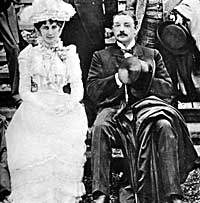
The 6th Duke of Portland with the Duchess in 1889.
There must have been a thrilling sensation of delight at the good fortune that had overtaken him when the present Duke found himself in possession of the family honours and estates. There had been so many vicissitudes in the Dukedom that any chance survival might have stepped in to bar his claim. “There’s many a slip between the cup and the lip” is an old saying, and many a relation of a great noble is near the succession of his honours, only to see them pass to some other branch where least expected.
The present Duke, or to give him his full family name, William John Arthur Charles James Cavendish-Bentinck, was a long way off the fifth Duke, in the table of consanguinity, he had no trace of the Scott blood in him, and was in fact only second cousin of his eccentric predecessor in the title.
His father was Lieutenant-General A. C. Cavendish-Bentinck, whose descent was through the third Duke, so that the two branches had to go back nearly a hundred years to find a common ancestor. His birth took place on December 28th, 1857, and it must have seemed then a remote possibility that in less than five and twenty years he would succeed to one of the proudest Dukedoms in the land, with the opportunities of a royal alliance.
Two of the Duke's half-brothers were engaged in the South African war; Lord Charles Bentinck was a Lieutenant in the 9th Lancers and was slightly wounded in the siege of Mafeking; for his services he won a medal and a brevet-majority. He was born in 1868 and was educated at Eton; he married in 1897 a daughter of Mr. Charles Seymour Grenfell of Taplow. In the East Midlands he has won considerable popularity as Master of the Blankney Hunt.
Lord William Bentinck was a Captain in the 10th Hussars and showed his ardour in the war by endeavouring to form a body of Colonial Mounted Rifles.
Among the eccentricities laid to the charge of the old Duke it was said that on his young heir going to visit him on one occasion at Welbeck, he ordered him to stand in a corner of the room.
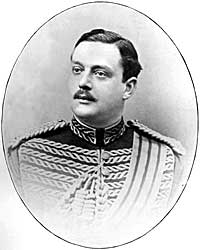
The 6th Duke of Portland.
When in 1879 the old Duke passed away from his world of mysteries and escapades, the heir was a Lieutenant in the Coldstream Guards. He was not long in the Army, and when he came into the title there were too many other engagements for him to attend to without troubling himself as to the routine of military duty, though he kept up a connection with the forces by becoming Lieutenant-Colonel of the Honourable Artillery Company of London Honorary Colonel of the 1st Lanarkshire Volunteer Artillery, and of the 4th Battalion Sherwood Foresters Regiment.
Welbeck soon began to assume a new aspect under his regime. Gradually it lost its appearance of a contractor's yard and looked like one of the stately homes of England.
Looking back to the time when he first came into his noble heritage, the Duke made a touching reference at the Welbeck Tenants' Show, in 1906, to the death of his agent, Mr. F. J. Turner, who for 48 years was in the service of the fifth Duke and himself.
"When I first came to Welbeck, now twenty-seven years ago," said the Duke, "I was a mere boy, very ignorant of the ways of the world, and more ignorant still, if it were possible, of business habits and of the management of a great estate. I shudder to think what might have been my fate, and the sad fate of those dependent upon me, if Mr. Turner and others, who guided my footsteps, had been different from what they proved themselves to be. It was in his power to make or mar the happiness and prosperity, not only of myself, but also of many of those who live in this district and who farm my land."
The Duke followed the traditions of his family and commenced to form an expensive racing stud.
In 1882 his attention was concentrated to a considerable degree upon this object. He bought the famous sire, St. Simon, at the sale of the late Prince Batthyany's horses. St. Simon could not compete in the classic races in consequence of the death of his owner, and all through his racing career he was not put to any severe test of speed, or most likely his name would have represented the double achievement of being a famous racer, and the sire of famous racers too. He was bought for 1,600l, the purchase being effected on the recommendation of Mat Dawson, the trainer, and the horse was then a two-year-old. That he could go at a terrific pace is proved by an observation made one day by Fred Archer to the trainer. St. Simon was at exercise when Archer's spur touched him, unintentionally by the jockey. He bounded into a gallop—a state of action rarely seen before—and Archer subsequently said that he had never been whizzed through the air at such a terrific pace. In the very pink of condition, fresh and strong, the Duke had to congratulate himself on securing his bargain, for he was sent from the course to the stud, with the result that the magnificent total of 246,000l. was won by his progeny in stakes alone.
At length, in 1888, the Duke reached the goal of his ambition in his career on the turf, for he was the winner of the Derby with Ayrshire, which also won the Two Thousand Guineas. Then he followed up his success next year by winning the Derby again with Donovan, a horse that also won the St. Leger.
The names of the mares finding their habitation at Woodhouse Hall, about a mile and a quarter from Welbeck Abbey, are identified with some of the most remarkable successes of the turf. Here is a string of animals through the veins of which ran purest blood. Amoena, Atalanta, Battlewings, Danceaway, Golden Bye, Lady Mar, Larissa, Marquesa, Mowerina, Modwena, Miss Middlewick, Shaker, Semolina, Staffa, Wheel of Fortune, Tact, Ulster Queen, and many besides. The Goddess of Fortune beamed on his Grace's colours whenever they appeared in the great races. The long series of victories resulted in immense winnings. For instance, Modwena was credited with 5,884l.; Ayrshire, 35,915l.; Johnny Morgan, 4.067l.; Donovan, 55,154l..; Semolina, 12.686l.; Miss Butterwick, 8.179l.; Eaeburn, 8,374l.; The Prize, 3.134l.; St. Serf, 5,809l.; Memoir, 17.300l.; Schoolbrook, 2,705l.; Amiable, 10,582l.; Other celebrated stock also bred by the Duke included Anna, Charm, Catcher Clatterfeet, Elsie, Eisteddfod, Galston, Katherine II., Little Go, Oyster, Rattleheels, St. Bridget, Simony II., The Task, The Owl, The Smew, Troon, Ulva, and many more. Major Loder's Spearmint was the winner of the Derby in 1906, and it was a bay colt by Carbine—Maid of the Mint, so that a horse owned by the Duke was again associated with the blue ribbon, Carbine having been imported from Australia by his Grace some years before. Carbine had another name, "Old Jack," given him because of his laziness, and a whip-stock had to be used occasionally to keep him up to the mark. An Australian picture of the horse was painted by Mr. W. Scott, and after being in the possession of Mr. Herbert Garratt for some years was sent to his Grace with a request that he would accept it, which he did.
All the time that the Duke was paying so much attention to horse-racing it was being asked in Nottinghamshire whether Welbeck was ever to see another Duchess of Portland. The palace of the magician in the heart of Sherwood Forest had not had a mistress for forty years, and the gossips were not diffident in expressing their opinion that it was time the splendour of its hospitality was graced by the presence of a Duchess.
The Duke was thirty-two years of age in 1889, and his name had been coupled with that of a royal princess; but whatever foundation there may have been for the rumour that he was going to marry into the royal family, it was seen eventually that he was determined to wed for love and not for pride of place.
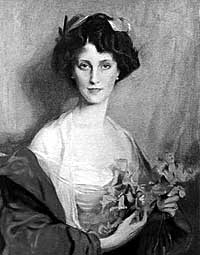
Duchess Winifred (nee Dallas-Yorke) in 1912.
Of the rich and well-born heiresses tracing their lineage through generation after generation of English chivalry, and who would have deemed it the prize of a lifetime to become Duchess of Portland, the Duke's choice fell upon a young lady whose name was unknown to the denizens of Nottinghamshire. She was Winifred, only daughter of Thomas Dallas-Yorke, Esq., of Walmsgate, Louth, and came of an old Lincolnshire family.
She was a merry girl as she used to ride her pony in the Lincolnshire lanes, indeed, she was regarded as somewhat of a tomboy, but a year or two passed away, and she surpised those who had known her in girlhood, to see her the most fashionable beauty in the Row.
She had a wondrous type of beauty too, that made all those who admired its style, fall beneath her spell, her complexion was delicate, yet with the glow of health upon it, her teeth were pearly, her eyes full of sweet reasonableness, her nose that of the classic heroines of Greece, and her willowy form such as Sir Joshua Reynolds would have delighted to paint in a portrait, that would have been one more justification of the poetical phrase, "Art is long and life is fleeting."
Her lithe and graceful figure, nearly six feet in height, with a face pleasing and mobile, and a voice that charmed in its tone, made her distinguished in any society where she appeared.
The story is that once when staying with some friends at Brighton she went to the Devil's Dyke, a romantic place visited by almost every tourist and resilient in that neighbourhood. There she was prevailed upon to consult a gipsy as to her future, and the fortune-teller prophesied truth, for the oracular words came forth:—
"You will carry off the greatest matrimonial prize in all England," the gipsy said, as she went through the palmistry study of Miss Dallas-Yorke's shapely hand: "but shortly after your marriage there's trouble of some sort, for the lines become cloudy. I know what it will be, young lady; a terrible illness must attack you, yet take courage and have no fear, my dear, for all will turn out well in the end."
The sequel to the story is that after the happy event of the marriage the gipsy had a black gown and a purse of money presented to her by the Duchess as a compliment to her sagacity as a prophetess.
The latter part of the prediction was fulfilled also, for soon after her marriage the Duchess was attacked by typhoid fever at Welbeck, and her life hung in the balance for a short time during her illness. Happily she recovered to take her place in Society, as graceful and winsome as ever.
She had been out, in the Society sense of the term, several seasons before she became acquainted with the Duke. How the meeting came about is thus related:—
She was on a visit during the autumn of 1888 to a country house in Scotland, and while waiting with her maid on the platform of Carlisle station, she was noticed by the Duke, who was also northward bound for sport on the moors.
The Duke was waiting on the platform too, and was attracted by the perfection of her appearance, her lofty carriage and the expression of the true gentlewoman on her countenance.
A few weeks afterwards an introduction took place at the house of a friend, when they spoke of their recollection of having seen each other on the platform of the railway station.
Although the Duke must have known that he was the most coveted matrimonial prize in England at that time, yet it is said he was shy at proposing to this magnificent daughter of a Lincolnshire squire.
He must have done, however, for in a few months the marriage was celebrated.
Soon after the engagement the Duke bought a sable cloak of immense value for his fiancee; but Mrs. Dallas-Yorke protested against the gift and said that her daughter had not been accustomed to such costly attire.
What was the Duke's observation upon this has not passed current; suffice it to say that the priceless cloak was received and worn by Miss Dallas-Yorke, who in Society was chaperoned by the Marchioness of Granby, now Duchess of Rutland.
Such a fluttering among Society dovecotes was seldom seen, and sound of wedding-bells rarely heard with such gleeful joy. It was a love-match, and, therefore, a popular event all over the land. Only a few weeks before, the Duke's horse had won the Derby, and the ovation given him by the racing fraternity was unprecedented to any one, peer or commoner, below royal rank.
Then the bride was so full of smiles to all who had the privilege of offering her congratulations.
The Duke had earned the reputation of being a "good fellow," a phrase carrying its own meaning in relation to a typical English nobleman. At the zenith of his popularity there is no wonder that crowds lined the streets on the wedding morning to catch a glimpse of the happy pair as they drove back from Church. The Prince and Princess of Wales honoured the ceremony with their presence, and such cheering there was as the faces of the bride and bridegroom were seen at the windows of the carriage. It was a smart equipage, and even the coachmen and footmen were decorated with horse-shoes of flowers on their coats.
Then there were the rejoicings at Welbeck, where the new Duchess soon ingratiated herself with the tenantry. "The Good Duchess" was smiling and approachable, and quickly found her way to the heart of the most churlish country herdsman.
It was apparent that the Duchess's mind was not solely occupied with plans for reigning in London Society and dictating the fashions for a select and fastidious circle. She knew her powers in that respect; she had already conquered and was content to please the Duke, and fulfil the duties of her station towards those who were her equals, and towards the Duke's retainers on his estates and their dependants.
Not that she ceased to dazzle with the radiant splendour of her jewels, which adorned her natural gracefulness.
Her coronet of diamonds contains in it a lustrous gem, called the Portland stone, worth 10,000l., and her jewels altogether are of fabulous value. Nothwithstanding the changing fashions of High Society, she retains her preference for a Medici collar of lace and a spray of Malmaison carnations.
With the immense sums of money the Duke had won over the Derby victories he was desirous of adding new treasures to his wife's jewel-case; but she prevailed upon him to build some almshouses for poor old women at Welbeck; moreover she is credited with having influenced him to moderate his indulgence in racing.
The almshouses, which were called "The Winnings," have upon them the following inscription: "These houses were erected by the sixth Duke of Portland at the request of his wife, for the benefit of the poor and to commemorate the the success of his race-horses." They were not built out of money made by betting, a habit not encouraged by the Duke.
At a later period, addressing a meeting of young men, he said: "Turn a cold shoulder to the bookmaker and those who would advise you to throw your money into the lap of fickle Fortune if you want to be happy. You might just as well throw the money into a pond."
The Duchess always has a happy way of opening a Bazaar for some philanthropic object, and her radiant and affable manner charm those with whom she is brought into contact, perhaps for the first time. She is a supporter of the Church Army Training Homes, Bryanston-street, and she has had the courage to preside over a temperance demonstration in Hyde Park. Swimming has become a fashionable accomplishment with Society ladies, and she has shown her interest in extending the cultivation of that exercise. This is only to mention but a few of the objects that claim her time and attention, and no lady of high position is more ready to aid a worthy charity where possible.
The first child that came to the Duke and Duchess was Lady Victoria Alexandrina Violet, born in 1890. She was highly honoured at her christening, for Queen Victoria acted as sponsor in person, and held the baby in her arms. There is at Welbeck an autograph letter from the Queen, congratulating the parents on their firstborn. The next was the heir to the Dukedom, William Arthur Henry, Marquis of Titchfield, born March 16th, 1893, and the third Lord Francis Norwen Dallas, born in 1900.
The Duke was Master of the Horse from 1886 to 1892, and from 1895 to 1905; and the Duchess acted as Mistress of the Robes for a short time in 1905, she was also one of the "Canopy Duchesses" at the Coronation.
The Duke's estates in Scotland include Langwell Lodge, which the family has frequently visited for deer-stalking and grouse-shooting in the autumn. Then there is Cessnock Castle, near Galston, Ayrshire, where the Duke and Duchess had not stayed for many years till 1906. A considerable part of the fifth Duke's Ayrshire estates, including the Kilmarnock property, passed at his death to his sister, Lady Ossington, and at her death to another sister, Lady Howard de Walden, and thence to Lord Howard de Walden. The Duke has extensive shootings at Fullarton, near Troon, and Fullarton House was for some time the residence of Louis Philippe of France.
The house of Langwell is situated on a beautiful grassy slope, with the sea in front, while in the background are the silver-clad Scarabines, rising with imposing grandeur. The Langdale and Berriedale rivers here join and flow into the sea, and there are picturesque gorges, with cave-dwellings and ancient ruins having historic associations. Frowning cliffs rise precipitously from the waves, and weird caves, only to be entered when the tide is low, add to the romantic character of the scenery.
In the neighbourhood of this favourite shooting lodge are some steep and dangerous hills which presented great difficulties to the horses when taking his Grace's guests to and fro to enjoy their sport. But having become a votary of the motorcar, these stiff hills have been surmounted with ease by the four or five vehicles which the Duke has acquired for sporting purposes. Helmsdale is the nearest railway station to Langwell, and the road over the Ord of Caithness includes several hills with rough and loose surfaces, and gradients ranging from 1 in 2 to 1 in 16, so that the journey is not without its stress both for horses and motorcars. John o' Groat's is forty-five miles distant, but this, as well as other places of interest in the neighbourhood, is within visiting range by the cars, though such long distances were not attempted with the equine species.
To capture the Master of the Horse as an auto-mobilist was a great achievement for enthusiasts in the advocacy of the new mode of travelling. The Duke of Portland has been such a devotee to the horse, as were his ancestors centuries before him, that it was not to be expected all at once, that he would, give his countenance to any new invention likely to supplant the noble animal in its position as the servant and friend of man. Having been a cyclist, when that hobby seized the fancy of the fashionable world, it was not a long step to automobilism, and having proved the superiority of the motor vehicle, the Duke gave orders for some of the best types of cars to be supplied to him. One of the most luxurious is a Limousine de Deitrich, and his interest in the new art of locomotion is such that he has had a perfect track prepared at Clipstone, called "The flying kilometre."
In 1907 the Duke became a member of the Royal Automobile Club and submitted all his drivers for examination for the certificate. The test took place at Welbeck, when there were shown several technical drawings executed by the candidates, who all passed with merit and received their certificates.
The Duchess on one occasion made some observations in public on motors, and expressed a doubt as to whether any of her friends would forsake the horse in favour of mechanical locomotion. That time, however, came about, and now the Duchess is claimed as a patroness of the car, which if prosy, compared with the delights of horsemanship, is, nevertheless, useful for accomplishing distances which horses are not expected to cover.
In a speech in the House of Lords, the Duke said he considered the advent of the motor-car could not but have a weakening influence on the horse-breeding industry, and before very long several of the functions which horses at present perform, both in the towns and country districts, would be carried out by mechanical means. His object in making these remarks was to call attention to what was impending in order that some steps might be taken to foster the horse-breeding industry.
As far as a continuance of interest in race-horses is concerned, the Duke had at the commencement of the season 1906 twenty-one horses in training with W. Waugh at Kingsclere, including thirteen two-year-olds.
Both King Edward and the Queen have been entertained at Welbeck since their accession to the throne, and in 1906 there was a visit from the Duke and Duchess of Sparta, the Crown Prince and Princess of Greece.
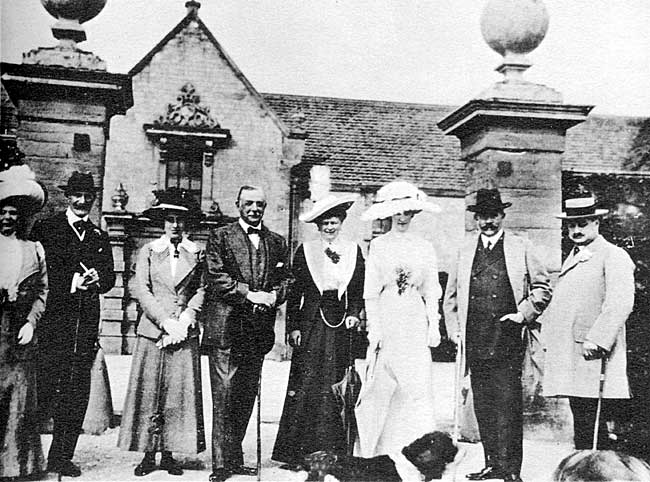
WELBECK, MAY, 1912 Above: H.I.H. the Archduke Franz Ferdinand Below: Countess Schonburg, Major Baker-Carr, Victoria Bentinck, Portland, Duchess of Hohenberg, Winifred Portland, Archduke Franz Ferdinand, Count Schonburg.
The Duke's sentiments on "patriotism" may be gathered from some remarks he made when opening a miniature rifle range constructed at the Nottingham High School. He referred with approbation to the work of Mr. Robins, Premier of Manitoba, through whose policy the Union Jack was unfurled from the roof of every school in the province: "The man who objects to perpetuating the glories of the flag, who declines to have his children infused with British patriotism is undesirable." "These words," said the Duke, "apply to the anti-patriot, the pro-Zulu, the pro-Boer, the inciter to rebellion in Egypt, and to the stirrer-up of strife in India. I do not see why rifle-shooting should not become a popular national sport, equal in prestige to games like cricket and football."