No. 1.
No. 2.
No. 3.
No. 4.
No. 5.
No. 6.
No. 7.
No. 8.
No. 9.
The agricultural subjects exhibit the Saxon labourers at work, while in others we see their Norman superiors enjoying themselves at their ease.
I will now give a short description of the subjects in order, taken from a paper I read at the Nottingham meeting of the Royal Archaeological Institute in 1900.1
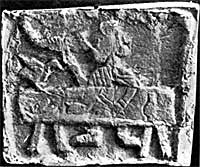
No. 1.—January is represented by a man seated at a trestle table laden with the good Christmas cheer of a boar's head and fat capon on flat round dishes, a loaf, and a flagon curiously inadequate to replenish the enormous drinking horn which the feaster is raising to his lips with his right hand. His left arm rests on the table, with knife in hand. His hawk, which I take to indicate that the figure is that of a Norman noble, stands on the edge of the table at his master's right side.
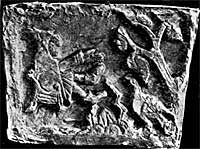
No. 2.—February, chill and raw, is humorously illustrated by a man in a hooded cloak and sleeved tunic, seated on a low chair with scroll back and arms, stretching out his left hand and heavily booted feet to the warmth of a crackling fire kindled out of doors beneath a tree, evidently an evergreen. His favourite bird is also enjoying the blaze. A similar design is to be seen in the carved oak misericord of the 14th century in Screveton Church.2
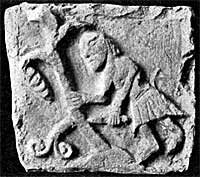
No. 3.—Here is a man engaged in pruning a tree or vine with a large knife. On the Burnham Deepdale font, this subject is allotted to April. In these agricultural subjects no doubt we see the Saxon labourers of the country at work.
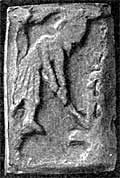
No. 4.—This represents a man holding in both hands an implement which may be a hoe or a crook stick, and which he seems to be using among growing crops. This has been supposed to represent ploughing, but I think the upright portion is intended for a plant. In the Burnham figure for June we have a man engaged in weeding with two sticks, the one in the left hand being a crook.
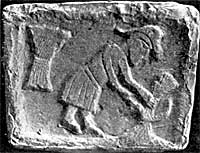
No. 5.—August is here prettily represented by a man reaping corn with a sickle. A neatly banded sheaf stands behind him. He is stripped to the waist, and wears a broad-brimmed hat suitable to the summer months.
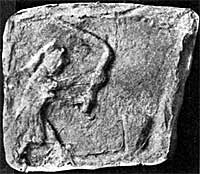
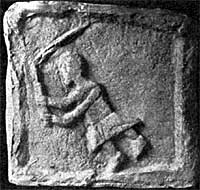
Nos. 6 and 7.—These two stones, each containing a separate panel, seem nevertheless to belong to a single month, September, and represent two men threshing corn with flails.
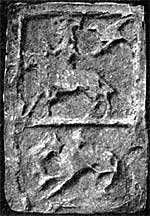
No. 8.—This is a larger rectangular stone which does not fit into the series of months on the arch. It may have belonged to the vertical band on the jamb. It is divided into two panels by a horizontal line. The upper compartment shows a man on horseback holding the reins in one hand and stretching out the other with his hawk upon it. The lower compartment represents a dog, the body like a greyhound, with a long tufted tail and large head. It has a hare or rabbit in its mouth.
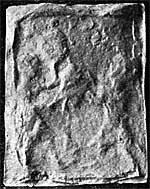
No. 9.—This stone is in the outer face of the north wall of the tower, near the ground, and is so much weather-worn that its subject is hardly to be discovered. It is about 9in. x 10in., and probably belonged, like the last, to the vertical part of the band. Two figures facing each other appear to be holding up something between them. I suggest that the figures are executing some kind of morris-dance, and perhaps holding a musical instrument.
Similar series of subjects representing the months are to be found on a Norman font at Burnham Deepdale, in Norfolk,3 in which the figures bear a striking resemblance to these at Calverton, and on a leaden font at Brookland, Kent,4 where the scenes are accompanied by the signs of the zodiac. The whole subject of mediaeval representations of the months is fully treated in Archaeologia XLIV. in a paper by Mr. J. Fowler.
Soon after 6 p.m. a start was made for Nottingham, the brakes reaching Victoria Station a little after 7 p.m., and bringing to a close an interesting excursion.
(1) Archaeological
Journal, vol. LVIII.
(2) Illustrated in English Church Furniture,
Cox and Harvey, 258.
(3) Archaeologia, X.
(4) Archaeological Journal, vol. LVII.