
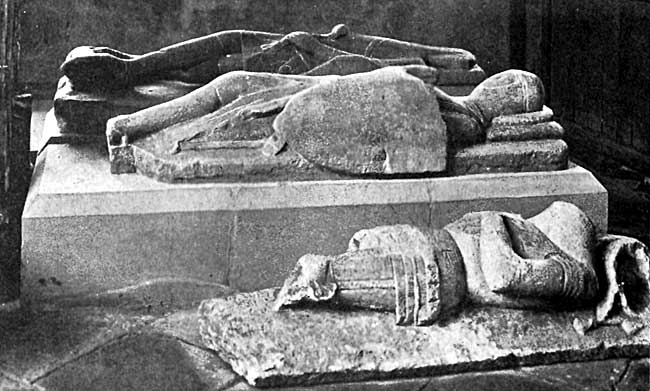
Effigies of the Everinghams, Laxton.
Following the figures in order of date, we must now re-cross the chancel and turn to the one in the south chapel. Here we have a later effigy, evidently that of Baron Adam de Everingham, the younger, who died in 1370. The costume is continuous in date and highly elaborated. The surcoat, now possibly of buckskin, is cut short, having lost every indication of a loose or folding garment, and takes the form of a jupon, fashionable from 1350 to the opening of the following century. The older ring-mail is here restricted to the head, neck, and body; plate armour, which afterwards became general, here makes an early appearance, the shoulders, elbows, lower limbs, and feet having this kind of protection, and the feet being also provided with prick or pointed toes, and furnished with rowel spurs. These last came into use about 1325. The figure is furnished with cuffed gauntlets, fashionable a few years later. This is a very late example of the crossed legs and the shield on the left arm. The figure is depicted in the attitude of using the sword, held by some to imply that the knight fell in battle. This effigy is wrought in Mansfield stone, of coarser grain and darker colour than in the first-mentioned example.
We will conclude our notice of this enviable group of knightly figures, in this old-world village, by noticing the headless trunk which lies beside the preceding ones on the floor of the chancel, wrought in the still more luxurious material of alabaster. Its richness has not preserved it from injury, for it is the most mutilated one in the whole collection. It is unquestionably the effigy of Baron Reginald de Everingham, the last of the stately family, if we except his youthful son, who only survived his father a short time. This Reginald died in 1399. In Thoroton's time the figure reposed on a raised tomb in the south chapel, with the Everingham lion rampant painted on the breast, as was the custom when the blazoned shield no longer figured on the left arm. In Throsby's time the head was broken off and placed in another part of the church. We have nothing now but an almost armless trunk. The head would have worn a conical or pointed basinet. The camail protecting the neck still obtains, a feature which disappeared by 1410, at which date also the tight-fitting jupon was replaced by plate armour. The jupon is here fringed on its lower edge. The hauberk, or ring-mail, beneath the jupon is further shortened, and plate armour covers the limbs. This tomb appears to have survived down to the late restoration, as some important remains of it are still in the churchyard against the north wall of the church.
The sword belt is worn horizontally across the hips, and is beautifully decorated with metal plates. The sword has moved to the left side, and a new instrument, the misericordia, or dagger, is introduced on the right side. Here for the first time we have the helm, or helmet, developed into an ostentatious detail. The older pillow supporting the head has disappeared, and the helm takes its place. The mutilated crest, an animal's head, surmounting it is probably the demi-lion of the Everinghams.
The introduction of the helm does not imply that it was a new piece of defensive armour. It was common in King John's time, and, being flat-topped, was called a pot-helmet. The helm was only used in battle and in tournaments, mainly to protect the face from the cut of the sword, which the head-gear, shown on the other figures, was incapable of doing.
It would seem that throughout the middle ages the wearing of the helmet was not considered seemly, when the knights were depicted in the attitude of prayer.
It is very satisfactory to know that these mediaeval treasures are in such safe hands as those of the present vicar of Laxton, who takes unbounded pride in his church and its interesting features, as well as in all the archaeological objects with which his parish abounds.
 |
 |